
One of the most surprising findings from recent research is just how strongly disc bulges are linked to lower back pain, and surprisingly, among younger adults. In fact, the prevalence of disc bulges in people is 20% in young adults, and over 75% in those over 70. But when someone under 50 is in pain and a bulge shows up on imaging, it’s a red flag that shouldn’t be ignored.
When left unaddressed, a bulging disc can irritate nearby nerves and start interfering with how you move, work, or live life in general. I see it all the time at my clinic, The Disc Chiropractic, here in Wheat Ridge, CO. I focus on getting to the root of each bulging disc and helping people without resorting to heavy dependence on medication or surgery.

What Is a Bulging Disc?
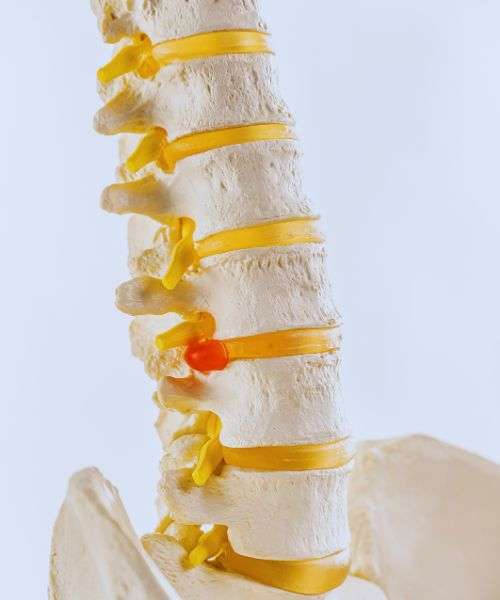
Your spine is made up of 24 bones called vertebrae, stacked one on top of the other. Between each pair of vertebrae is a spinal disc, a cushion-like structure that acts as a shock absorber and allows your spine to move and bend smoothly.
Each disc has two main parts:
- The nucleus pulposus – a soft, gel-like center
- The annulus fibrosus – a tough, outer ring of cartilage that holds everything in place
Over time, or due to repetitive stress or injury, the outer ring can weaken. When that happens, the disc can start to bulge outward.
Think of it like squeezing a jelly donut. The filling doesn’t break through, but the outer shape changes. That outward pressure is what we call a bulging disc.
Common Symptoms of a Bulging Disc
When a bulging disc presses on spinal nerves, especially in the lumbar spine (lower back) or cervical spine (neck), you may experience:
- Persistent back pain or neck pain
- Numbness or tingling in the arms or legs
- Muscle weakness, especially in the affected areas
- Radiating pain into the leg (sciatica) or the shoulder and arm
Common Causes of a Bulging Disc
A bulging disc doesn’t just appear out of nowhere. Below are some of the most common factors that weaken the disc and lead to bulging.
Degenerative Disc Disease
As we age, spinal discs naturally lose hydration and elasticity. This process, called disc desiccation, makes the discs thinner and less capable of absorbing shock. As the outer wall weakens, the disc becomes more likely to bulge under everyday pressure, especially in the lower back and neck.
Poor Posture
Spending long hours slouched over a desk or driving with poor posture puts uneven stress on your spine. This throws off normal spinal biomechanics, which means certain discs take on more wear and tear than they’re designed for, leading to earlier breakdown and bulging.
Repetitive Strain from Everyday Movements
Frequent bending, lifting, or twisting, especially with improper technique, creates ongoing stress on the spinal discs. These microtraumas may not cause pain right away, but over time, they weaken the disc wall and lead to bulging.
Trauma
A sudden injury, such as a car crash or sports impact, can overload a disc and cause it to deform. Even if pain doesn’t show up immediately, trauma can accelerate structural changes inside the disc and trigger symptoms later.
Genetics
Some people are simply more prone to disc problems due to inherited traits. Genetics can influence the collagen structure of the disc, how quickly it loses hydration, or how well it handles mechanical stress.
If disc issues run in your family, your risk may be higher, even if your lifestyle is relatively active or low-impact.

A Disc Bulge is Not a Disc Herniation
People often think a bulging disc and a herniated disc are the same thing—but they’re not. While both affect the spinal discs and can cause similar symptoms, the way they develop and how they are treated can be very different.
According to the North American Spine Society (NASS) and other leading radiology associations, a disc bulge is a broad and gradual extension of the outer part of the disc, called the annulus fibrosus. The disc remains intact but becomes misshapen, usually due to degeneration or long-term pressure on the spine. A bulge typically involves more than 25% of the disc’s outer edge.
A herniated disc, on the other hand, is more focused and often more severe. In this case, the inner gel-like material, the nucleus pulposus pushes through a tear in the outer wall.
This can cause more pain in your back and put direct pressure on nearby spinal nerves.
Proven Treatments We Use for Bulging Discs
When it comes to treating a bulging disc, the key is precision. At my clinic, I don’t rely on general protocols. Below are the core treatments I use to help reduce disc pressure and prevent bulging disc from coming back.

Chiropractic Adjustments
I use a very specific style of chiropractic care rooted in the Gonstead technique. That means no guessing, and no general “cracking” of the spine. Every adjustment is targeted to correct the exact spinal segment that’s misaligned and adding stress to your disc.
These full-spine corrections help restore proper joint motion, reduce inflammation, and improve the mechanical balance of your spine, all of which takes pressure off the disc so it can start to recover.

Spinal Decompression Therapy
For many patients with a bulging disc, I also recommend non-surgical spinal decompression using the Triton DTS system. This therapy gently stretches the spine in a controlled way, creating negative pressure inside the disc.
That pressure helps draw bulging material inward and relieve tension on nearby nerve roots. It’s painless, calming, and highly effective when done consistently as part of a focused treatment plan.

Therapeutic Exercises and Posture Correction
Adjustments and spinal decompression are powerful tools but your long-term stability depends on how your body moves and holds itself day to day. That’s why I teach targeted therapeutic exercises to strengthen the muscles that hold your spine, and retrain your posture.
I often use techniques like McKenzie extensions to help centralize pain and restore disc mechanics. We also focus on spinal mobility and body awareness to reduce the risk of future flare-ups.
FAQs About Bulging Discs
How Long Does It Take To Heal a Bulging Disc With Chiropractic Care?
In many cases, patients see improvement within 4 to 6 weeks of starting chiropractic care, especially when supported with strengthening exercises. More chronic cases may take 8 to 12 weeks or longer for noticeable and sustained relief.
Is Spinal Decompression Therapy Effective for a Bulging Disc?
Research shows that non-surgical spinal decompression therapy can improve disc height and help retract bulging material back to its normal position.
What Does a Chiropractor Do for a Bulging Disc in the Lower Back?
Chiropractors use manual adjustments for lumbar disc bulges; this includes specific adjustments to the bones on the restricted spinal segments. I for one can use a device to aid with adjustments.
Will I Need an MRI or X-Rays to Treat My Bulging Disc?
X-rays are commonly used at the start of care to evaluate spinal alignment and disc spacing. An MRI may be recommended if neurological symptoms are present (like numbness, weakness, or radiating pain).
Does Chiropractic Care Help With Sciatica From a Bulging Disc?
Yes, in many cases. When a bulging disc compresses the sciatic nerve, it can lead to radiating leg pain, numbness, and tingling sensations. Chiropractic care can help relieve that pressure by targeting the misalignments causing the nerve irritation.
Let’s Get You Moving Again
Don’t wait for your bulging disc to get worse. The sooner we find out what’s really going on, the sooner we can start fixing it with a plan built just for you.
Your first visit is just $97 and includes a full consultation, spinal exam, and a clear explanation of what we find.
Book an Appointment Now or Call: 720-573-4910 to get started.