
Surgery is often presented as the inevitable answer to disc problems. A herniated disc, a compressed nerve, progressive neck pain with radiating symptoms down the arm, and suddenly the conversation turns to procedures that cost $20,000 to $50,000, require weeks of recovery, and carry real risks of complications.
What most patients are never told is that the majority of disc-related conditions respond to the right combination of conservative care, and that surgery, when pursued too early, often produces no better long-term outcome than structured non-surgical treatment.
At The Disc Chiropractic, we built our Disc Recovery program specifically for patients who are facing that conversation.
It combines three of the most evidence-supported non-surgical modalities available, chiropractic adjustments, spinal decompression therapy, and shockwave therapy, into a single, coordinated treatment pathway designed to address disc and nerve conditions in both the lumbar (lower back) and cervical (neck) spine.

What Is the Disc Recovery Program?
Disc Recovery is our answer to the gap between “keep doing what you’re doing and hope it gets better” and “you need surgery.” It is designed for patients with diagnosed or suspected disc conditions who want a real, structured, evidence-based path to recovery without going under the knife.
Your program combines chiropractic adjustments, spinal decompression, shockwave therapy, and therapeutic exercises across a defined series of treatment sessions.
Each service has a specific role in your recovery, and the frequency and combination of treatments are adjusted based on your individual needs.
Your first visit with Dr. Kevin Canizales establishes the foundation for your plan. He reviews your history, evaluates your spine, interprets your X-rays, and uses advanced diagnostics such as nervoscope testing when nerve involvement is suspected.
This allows the doctors to determine what is happening in your spine before your treatment plan begins.
From there, our team of doctors would guide you through your treatment program, combining the appropriate therapies in a specific sequence and frequency. The goal is not simply to manage your symptoms, but to address the underlying factors contributing to your disc pain and give your spine the best opportunity to recover without surgery.
What Conditions Does Disc Recovery Address?
Disc Recovery is designed for spinal conditions affecting the lumbar and cervical spine where disc pathology, nerve compression, joint dysfunction, or the resulting soft-tissue problems may be contributing to pain and limited movement.
Sciatica
A lumbar disc herniation occurs when the inner, gel-like portion of a disc pushes through its outer ring and may irritate or compress a nearby nerve root.
When this affects the nerves that contribute to the sciatic nerve, pain, numbness, tingling, or weakness can travel from the lower back into the buttock, leg, or foot.
Lower Back Pain
Not all lower back pain follows a clear nerve pattern. Disc degeneration, changes in spinal movement, segmental instability, and irritation of the facet joints can all contribute to mechanical low back pain.
Disc Recovery addresses these contributing factors through a combination of treatments rather than focusing only on the location of the pain.
Lumbar Facet Joint Syndrome
The facet joints are small joints located at the back of each vertebra that help guide spinal movement. Degeneration or irritation in these joints can cause localized lower back pain or pain that refers in to the surrounding areas.
When facet dysfunction is contributing to your symptoms, it can be incorporated into your Disc Recovery treatment plan.
Lumbar Myofascial Pain and Trigger Points
Disc and joint problems can cause the surrounding muscles to tighten and remain under prolonged stress. Over time, this may lead to painful trigger points and persistent tension in the lower back, glutes, and other supporting muscles.
Addressing these soft-tissue problems can be an important part of restoring normal movement and reducing pain.
Spinal Stenosis
Lumbar spinal stenosis occurs when the spaces available for the spinal cord or nerve roots become narrowed. This can contribute to leg pain, heaviness, numbness, or cramping, particularly during standing or walking.
Disc Recovery may be appropriate for some patients with mild to moderate stenosis depending on the underlying cause and individual clinical findings.
Cervical Disc Herniation
A cervical disc herniation can irritate or compress a nerve root in the neck, causing pain, numbness, tingling, or weakness that travels into the shoulder, arm, or hand.
Your evaluation helps determine whether nerve involvement is contributing to your symptoms and whether a non-surgical treatment approach is appropriate.
Cervical Myofascial Pain Syndrome
Chronic dysfunction in the cervical spine can place additional stress on the surrounding muscles, including the upper trapezius, levator scapulae, and scalene muscles.
This can lead to persistent muscle tension and trigger points that contribute to neck pain, stiffness, and restricted movement.
Cervicogenic Headaches
Some headaches originate from structures in the neck rather than from a primary neurological or vascular condition. Irritation or dysfunction involving the cervical joints, muscles, and nerves can contribute to headaches that begin in the neck and may travel toward the head.
When your evaluation indicates a cervical source, addressing the underlying neck dysfunction may be part of your Disc Recovery plan.
How the Three-Modality Approach Works
Each of the three treatments in the Disc Recovery program addresses a different dimension of disc-related spinal pain.
Combining them is not arbitrary. It reflects the clinical reality that disc conditions are rarely one-dimensional, and that addressing only one part of the problem, whether the nerve, the disc, or the surrounding soft tissue, leaves the other parts to perpetuate the pain cycle.
Chiropractic Adjustments
Clinical practice guidelines list spinal manipulation (SMT) as a first-line conservative treatment for both lumbar and cervical spinal pain.
A 2025 systematic review found that multimodal manipulation-based care combining adjustments, mobilization, and soft tissue work was the most effective approach for reducing neck pain intensity and disability, with manipulation alone producing the best results for improving cervical range of motion.
For lumbar disc conditions, current evidence supports chiropractic adjustments as part of multimodal conservative care for lumbar disc herniation with radiculopathy, with careful screening to ensure the approach is appropriate for each patient’s specific presentation.
Chiropractic adjustments work in the context of Disc Recovery by restoring proper motion to spinal segments that have become restricted or misaligned, reducing the mechanical irritation on nearby nerve roots, and allowing surrounding muscles to release from protective spasm.
When segments move properly, the other components of the program, decompression and shockwave therapy, work more effectively.
Dr. Ricky Roope leads all adjustments and hands-on treatment in the program. His approach is calibrated to the patient’s diagnosis and tolerance, with low-force mobilization techniques used in more acute or sensitive presentations and progressive loading as recovery advances.
Spinal Decompression Therapy
Spinal decompression therapy is the component of the Disc Recovery program most directly targeted at the disc itself.
By gently and precisely distracting the vertebral segments, decompression creates a negative intradiscal pressure that can draw herniated disc material back toward the center of the disc, reduce compression on affected nerve roots, and improve the movement of nutrients into the disc to support healing.
Research has measured intradiscal pressure dropping from -25 to as low as -160 mm Hg during decompression therapy, creating the environment the disc needs to retract and recover.
For cervical disc conditions, mechanical cervical traction and decompression are consistently included in conservative management pathways for cervical radiculopathy as a method for reducing nerve root compression and associated arm symptoms.
In the Disc Recovery program, decompression sessions are structured and progressive, not a passive modality applied the same way each visit. The protocol is adjusted based on which level is involved, the direction of herniation, and how the patient is responding week by week.
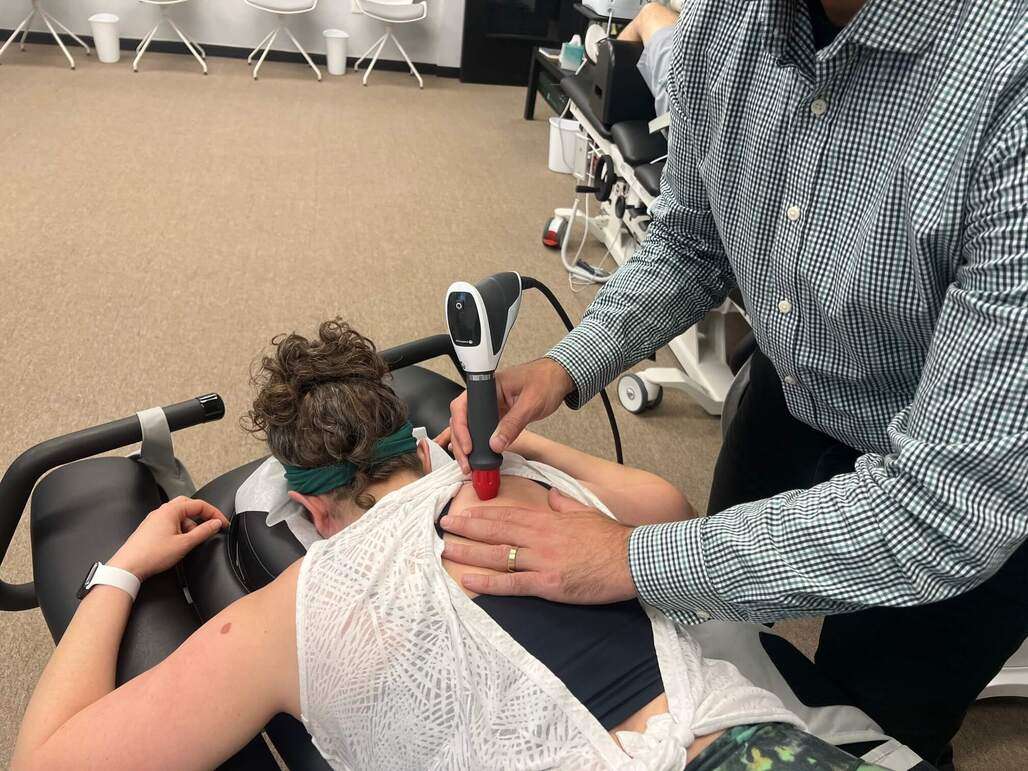
Shockwave Therapy:
Shockwave therapy (ESWT) is the most evidence-supported non-invasive modality for addressing this soft tissue dimension of disc recovery. A 2025 randomized sham-controlled trial found that focused ESWT significantly reduced lumbar facet joint pain compared to sham, supporting its role in both facet-mediated and myofascial components of low back pain.
Multiple RCTs and meta-analyses confirm that ESWT significantly reduces pain and trigger point sensitivity in both lumbar and cervical myofascial pain syndromes, with benefits lasting months beyond the treatment period.
For cervical presentations, recent RCTs show that adding radial ESWT to manual therapy produces significantly greater improvements in cervical muscle stiffness, pain, and mechanical sensitivity than manual therapy alone.
This makes shockwave therapy a particularly valuable addition to the cervical component of Disc Recovery, addressing the upper trapezius, levator scapulae, and scalene trigger points that are almost universally present in patients with chronic cervical disc dysfunction.

Why Non-Surgical Disc Recovery Works.
The evidence is consistent that surgery is not the only path forward for disc conditions, and that for the majority of patients, it is not the necessary first path.
What patients need is a program that takes their diagnosis seriously, applies treatments with documented mechanisms and clinical outcomes, and adjusts the approach based on real progress rather than protocol alone.
Disc conditions can heal. Discs can resorb, nerve roots can decompress, and the surrounding soft tissue can recover, when given the right environment and the right stimulus.
The Disc Recovery program at The Disc Chiropractic is designed to provide exactly that.
FAQs About Disc Recovery
What types of disc conditions does the Disc Recovery program treat?
Disc Recovery is designed for both lumbar and cervical disc conditions, including herniated and bulging discs with or without radiculopathy, facet joint syndrome, myofascial pain from chronic spinal dysfunction, lumbar spinal stenosis (mild to moderate), and cervicogenic headaches. Dr. Canizales will determine on Day 1 whether your specific presentation is appropriate for the program.
Is Disc Recovery an alternative to back or neck surgery?
Yes, that is precisely what it is designed for. The program combines chiropractic adjustments, spinal decompression, and shockwave therapy to address disc and nerve conditions through conservative, non-surgical means. For many patients, this approach produces outcomes comparable to surgery without the cost, recovery time, or procedural risks. Surgery remains an option if conservative care does not produce adequate improvement, but Disc Recovery is built to make that conversation less likely.
How is Disc Recovery different from a regular chiropractic visit?
A standard chiropractic visit typically involves adjustments and possibly some soft tissue work applied to a presenting complaint. Disc Recovery is a structured multi-modality program specifically designed for spinal disc conditions. It combines three distinct treatment approaches, each targeting a different part of the problem, and it is built around a diagnostic foundation established on Day 1 with Dr. Canizales rather than beginning treatment at the first visit.
How many sessions does the Disc Recovery program take?
This depends on the specific condition, how long it has been present, and how your body responds to treatment. Disc herniation cases with acute radiculopathy typically see meaningful improvement within several weeks of consistent treatment. More chronic or complex presentations may require a longer program. Most patients are seen multiple times per week in the early phase, with frequency reducing as recovery progresses.
Does spinal decompression actually help discs heal?
Research has measured intradiscal pressure dropping dramatically during decompression therapy, creating the negative pressure environment that allows herniated disc material to retract toward the center of the disc. This, combined with improved nutrient flow into the disc, supports genuine structural healing rather than just temporary pain relief. A 2025 retrospective review of nonsurgical decompression for low back pain reported large pain reductions and functional gains across the patient group.
What does shockwave therapy do for disc conditions?
Shockwave therapy in the Disc Recovery program is primarily targeted at the soft tissue consequences of disc dysfunction: the trigger points, myofascial tension, and referred pain patterns that develop in the paraspinal, gluteal, and hip muscles with lumbar conditions, and in the upper trapezius, scalenes, and levator scapulae with cervical conditions. A 2025 randomized controlled trial found focused ESWT significantly reduced lumbar facet joint pain, and multiple meta-analyses confirm its effectiveness for myofascial trigger point pain in both the lumbar and cervical regions.
Can Disc Recovery help with cervical disc problems and neck pain?
Yes. The program addresses both lumbar and cervical presentations. For cervical disc herniation with radiculopathy, the program combines gentle adjustments, cervical decompression, and shockwave therapy targeting the neck and upper shoulder musculature. Recent RCT evidence shows that adding shockwave therapy to manual care produces significantly better outcomes for cervical muscle stiffness and pain than manual therapy alone.
Is Disc Recovery appropriate for lumbar spinal stenosis?
For mild to moderate lumbar spinal stenosis, yes. A 2026 systematic review found that spinal manipulation may offer comparable or modestly greater benefit than other treatments for chronic spinal conditions including lumbar spinal stenosis. Flexion-based decompression techniques are also used for degenerative stenosis to improve canal and foraminal space. Severe stenosis with significant neurological compromise may require surgical evaluation, which Dr. Canizales will assess and refer for appropriately.
What happens if Disc Recovery does not resolve my symptoms?
If conservative care is not producing adequate improvement after a genuine trial, our team will communicate that clearly and provide appropriate referrals for surgical evaluation or further diagnostic imaging. We do not keep patients in treatment that is not working. Our goal is your recovery, by whatever path gets you there.
How do I get started with Disc Recovery?
You start with a Day 1 visit with Dr. Kevin Canizales. That visit includes a full consultation, spinal examination, X-rays, advanced diagnostics if needed, and a complete report of findings with a customized Disc Recovery plan. The new patient special is $97 (regularly $150). Call 720-573-4910 or book online to schedule.
Start Your Disc Recovery Today
Living with disc pain, radiating nerve symptoms, or a spine that limits what you can do every day is not something you have to accept as permanent.
Our team at The Disc Chiropractic, Dr. Kevin Canizales, Dr. Al Simeone, and Dr. Ricky Roope, is here to give you a clear picture of what is happening in your spine and a structured, evidence-based plan to address it without surgery.
The sooner you start, the more options you have.
Call: 720-573-4910